| Édith Piaf | |
|---|---|
 Piaf in 1939 | |
| Groundwork data | |
| Nascence name | Édith Giovanna Gassion |
| Too known as | La Môme Piaf ( The Picayune Sparrow ) |
| Born | (1915-12-19)19 Dec 1915 Paris, France |
| Died | 10 October 1963(1963-10-ten) (anile 47) Plascassier, Grasse, France |
| Genres |
|
| Occupation(s) |
|
| Years active | 1935–1963 |
| Labels |
|
| Associated acts |
|
Édith Piaf (, ,[1] French: [edit pjaf] (  listen ); born Édith Giovanna Gassion, French: [edit dʒɔvana ɡasjɔ̃]; 19 Dec 1915– x Oct 1963) was a French singer noted as France'due south national chanteuse and one of the country'south about widely known international stars.[ii]
Piaf'south music was oftentimes autobiographical, and she specialized in chanson and torch ballads about dearest, loss and sorrow. Her virtually widely known songs include "La Vie en rose" (1946), "Non, je ne regrette rien" (1960), "Hymne à l'amour" (1949), "Milord" (1959), "La Foule" (1957), "L'Accordéoniste" (1940), and "Padam, padam..." (1951).
Since her death in 1963, several biographies and films have studied her life, including 2007's La Vie en rose. Piaf has become one of the nigh celebrated performers of the 20th century.[3]
Family [edit]
Despite numerous biographies, much of the truth of Piaf'south life is unknown.[4] She was born Édith Giovanna Gassion[5] in Belleville, Paris. Legend has it that she was born on the pavement of Rue de Belleville 72, but her nascency document says that she was born on 19 December 1915 at the Hôpital Tenon, a hospital located in the 20th arrondissement.[6]
She was named Édith afterwards the Earth War I British nurse Edith Cavell, who was executed 2 months earlier Édith's birth for helping French soldiers escape from German captivity.[seven] Piaf – slang for "sparrow" – was a nickname she received 20 years later.
Louis Alphonse Gassion (1881–1944), Édith's father, was a street performer of acrobatics from Normandy with a past in the theatre. He was the son of Victor Alphonse Gassion (1850–1928) and Léontine Louise Descamps (1860–1937), known as Maman Tine, a "madam" who ran a brothel in Bernay in Normandy.[8]
Her mother, Annetta Giovanna Maillard, amend known professionally equally Line Marsa (1895–1945), was a vocalizer and circus performer born in Italy of French descent on her father'south side and of Italian and Kabyle on her mother'southward.[9] [10] [xi] Her parents were Auguste Eugène Maillard (1866–1912) and Emma (Aïcha) Saïd Ben Mohammed (1876–1930), daughter of Said ben Mohammed (1827–1890), an acrobat born in Mogador[12] and Marguerite Bracco (1830–1898), born in Murazzano in Italy.
Annetta and Louis-Alphonse divorced on four June 1929.[13] [fourteen]
Early life [edit]

Piaf's female parent abandoned her at nativity, and she lived for a brusk time with her maternal grandmother, Emma (Aïcha). When her father enlisted with the French Regular army in 1916 to fight in World State of war I, he took her to his mother, who ran a brothel in Bernay, Normandy. There, prostitutes helped look after Piaf.[2] The bordello had ii floors and vii rooms, and the prostitutes were not very numerous – "nearly x poor girls", as she later described. In fact, 5 or half-dozen were permanent while a dozen others would bring together the brothel during market days and other busy days. The sub-mistress of the brothel was called "Madam Gaby" and Piaf considered her almost similar family, since she became godmother of Denise Gassion, Piaf's half-sister born in 1931.[15] Edith believed her weakness for men came from mixing with prostitutes in her grandmother'southward brothel.
From the age of iii to vii, Piaf was allegedly blind as a result of keratitis. Co-ordinate to one of her biographers, she recovered her sight after her grandmother'south prostitutes pooled coin to accompany her on a pilgrimage honouring Saint Thérèse of Lisieux. Piaf claimed this was the consequence of a miraculous healing.[16]
In 1929, at age 14, she was taken by her father to join him in his acrobatic street performances all over France, where she first began to sing in public.[17] At the age of 15, Piaf met Simone "Mômone" Berteaut, who may accept been her one-half-sister, and who became a companion for nigh of her life. Together they toured the streets singing and earning money for themselves. With the additional coin Piaf earned as role of an acrobatic trio, she and Mômone were able to hire their own place;[2] Piaf took a room at Grand Hôtel de Clermont (eighteen rue Véron, 18th arrondissement of Paris), working with Mômone as a street vocalist in Pigalle, Ménilmontant, and the Paris suburbs (cf. the song "Elle fréquentait la rue Pigalle").
In 1932, she met and vicious in love with Louis Dupont. Within a very curt fourth dimension, he moved into their small room, where the three lived despite Louis' and Mômone's dislike for each other. Louis was never happy with the idea of Piaf's roaming the streets, and continually persuaded her to take jobs he found for her. She resisted his suggestions, until she became pregnant and worked for a short while making wreaths in a factory.[xviii]
In February 1933, the 17-year-former Piaf gave nascency to her daughter, Marcelle (nicknamed Cécelle) at the Hôpital Tenon. Like her female parent, Piaf found it difficult to care for the kid and had petty parenting noesis. She rapidly returned to street singing, until the summer of 1933, when she started performing at Juan-les-Pins, Rue Pigalle.[18]
Following an intense quarrel over her behavior, Piaf left Louis Dupont (Marcelle's male parent) taking Mômone and Marcelle with her. The 3 stayed at the Hôtel Au Clair de Lune, Rue André-Antoine. During this time, Marcelle was often left lonely in the room while Piaf and Mômone were out on the streets or at the order singing. Dupont eventually came and took Marcelle abroad, saying that if Édith wanted the kid, she must come home. Like her own mother, Piaf decided not to come domicile, though she did pay for childcare. Marcelle died of meningitis at age 2.
Singing career [edit]
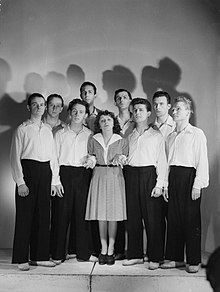
In 1935, Piaf was discovered in the Pigalle area of Paris[2] by nightclub possessor Louis Leplée,[five] whose order Le Gerny'southward off the Champs-Élysées[8] was frequented by the upper and lower classes alike. He persuaded her to sing despite her extreme nervousness, which, combined with her height of only 142 centimetres (four ft viii in),[6] [nineteen] inspired him to give her the nickname that would stay with her for the rest of her life and serve as her stage name, La Môme Piaf [five] (Paris slang meaning "The Waif Sparrow" or "The Little Sparrow").[2] Leplée taught her the basics of phase presence and told her to wear a black dress, which became her trademark dress.[ii]
Leplée ran an intense publicity campaign leading upwards to her opening dark, attracting the presence of many celebrities, including actor and singer Maurice Chevalier.[2] The bandleader that evening was Django Reinhardt, with his pianist, Norbert Glanzberg.[iii] : 35 Her nightclub gigs led to her first two records produced that aforementioned year,[xix] with i of them penned by Marguerite Monnot, a collaborator throughout Piaf's life and one of her favourite composers.[two]
On six April 1936,[2] Leplée was murdered. Piaf was questioned and defendant as an accessory, but acquitted.[v] Leplée had been killed by mobsters with previous ties to Piaf.[twenty] A barrage of negative media attention[6] now threatened her career.[2] To rehabilitate her image, she recruited Raymond Asso, with whom she would go romantically involved. He changed her phase name to "Édith Piaf", barred undesirable acquaintances from seeing her, and commissioned Monnot to write songs that reflected or alluded to Piaf's previous life on the streets.[2]
In 1940, Piaf co-starred in Jean Cocteau's successful comedy play Le Bel Indifférent.[ii] The German occupation of Paris did not stop her career; she began forming friendships with prominent people, including Chevalier and poet Jacques Bourgeat. She wrote the lyrics of many of her songs and collaborated with composers on the tunes. Spring 1944 saw the outset cooperation and a love affair with Yves Montand in the Moulin Rouge.[6] [twenty]
In 1947, she wrote the lyrics to the vocal "Mais qu'est-ce que j'ai ?" (music by Henri Betti) for Yves Montand. She contributed greatly to the revolutionizing of the cabaret-genre. Within a year, he became one of the most famous singers in French republic. She broke off their relationship when he had become almost as popular as she was.[2]

During this fourth dimension, she was in smashing demand and very successful in Paris[5] as France's almost popular entertainer.[xix] After the war, she became known internationally,[five] touring Europe, the The states, and South America. In Paris, she gave Atahualpa Yupanqui (Héctor Roberto Chavero) – a cardinal figure in the Argentine folk music tradition – the opportunity to share the scene, making his debut in July 1950. She helped launch the career of Charles Aznavour in the early on 1950s, taking him on tour with her in French republic and the U.s.a. and recording some of his songs.[ii] At first she met with niggling success with American audiences, who expected a gaudy spectacle and were disappointed by Piaf's simple presentation.[2] Afterward a glowing 1947 review in the New York Herald Tribune by the influential New York critic Virgil Thomson, himself a contributor to international avant-garde civilization, her popularity grew[21] [2] to the point where she eventually appeared on The Ed Sullivan Show viii times, and at Carnegie Hall twice (1956[8] and 1957).
Piaf wrote and performed her signature song, "La Vie en rose",[2] in 1945 and it was voted a Grammy Hall of Fame Honour in 1998.
Bruno Coquatrix's famous Paris Olympia music hall is where Piaf achieved lasting fame, giving several series of concerts at the hall, the most famous venue in Paris,[6] between January 1955 and October 1962. Excerpts from five of these concerts (1955, 1956, 1958, 1961, 1962) were issued on tape and on CD, and accept never been out of print. In the 1961 concerts, promised by Piaf in an effort to save the venue from bankruptcy, she get-go sang "Not, je ne regrette rien".[6] In April 1963, Piaf recorded her last song, "L'Homme de Berlin".
Role during the German occupation [edit]
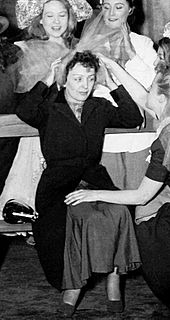
Piaf at the ABC music hall in Paris in 1951
Piaf's career and fame gained momentum during the German occupation of France.[22] She performed in diverse nightclubs and brothels, which flourished during the 1940–1945 Années érotiques (book title of Patrick Buisson, director of the French history channel).[23] [24] Various top Paris brothels, including Le Chabanais, Le Sphinx, Ane Two Two,[25] La rue des Moulins, and Chez Marguerite, were reserved for German officers and collaborating Frenchmen.[26] She was, for case, invited to take part in a concert bout to Berlin, sponsored by the German officials, together with artists such as Loulou Gasté, Raymond Souplex, Viviane Romance and Albert Préjean.[27] In 1942, Piaf was able to afford a luxury flat in a house in the fancy 16th arrondissement of Paris (today rue Paul-Valéry).[28] She lived in a higher place the Fifty'Étoile de Kléber, a famous nightclub and bordello close to the Paris Gestapo headquarters.[29]
Piaf was deemed to have been a traitor and collaborator. She had to show before a purge panel, as in that location were plans to ban her from appearing on radio transmissions.[iii] However, her secretary Andrée Bigard, a member of the Résistance, spoke in her favour after the Liberation.[29] [thirty] According to Bigard, she performed several times at prisoner of war camps in Germany and was instrumental in helping a number of prisoners escape.[31] Piaf was very pop amongst Nazis; therefore, she was able to help those living difficult times. In fact, at the get-go of World State of war II, she worked professionally with Michel Emer, a famous Jewish musician whose song "L'Accordéoniste" was soon adored by many. Piaf paid for Emer's way into France earlier German occupation. He lived in France in safety until the liberation.[31] [32] [33] Piaf was apace back in the singing business and in December 1944, she went on stage for the Allied forces together with Montand in Marseille.[three]
Personal life [edit]

Piaf with her 2d hubby Théo Sarapo in 1962
At age 17 Piaf had a girl, Marcelle, who died anile 2. Piaf neither wanted nor had other children.
The honey of Piaf'south life, the married boxer Marcel Cerdan, died in a airplane crash in October 1949, while flying from Paris to New York City to meet her. Cerdan's Air France flight, on a Lockheed Constellation, crashed in the Azores, killing anybody on board, including noted violinist Ginette Neveu.[34] Piaf and Cerdan's affair made international headlines,[half-dozen] as Cerdan was the onetime middleweight world champion and a legend in French republic in his own right.
In 1951, Piaf was seriously injured in a car crash along with Charles Aznavour, breaking her arm and two ribs, and thereafter had serious difficulties arising from morphine and alcohol addictions.[2] Ii more about-fatal car crashes exacerbated the situation.[8] Jacques Pills, a vocalist, took her into rehabilitation on three unlike occasions to no avail.[2]
Piaf married Jacques Pills (real name René Ducos), her first husband, in 1952 (her matron of honour was Marlene Dietrich) and divorced him in 1957. In 1962, she wednesday Théo Sarapo (Theophanis Lamboukas), a singer, actor, and erstwhile hairdresser who was born in French republic of Greek descent.[2] Sarapo was xx years her junior. The couple sang together in some of her last engagements.
Piaf lived mainly in Belleville, Paris, with her father from 1915 to 1931. From 1934 to 1941, she lived at 45 rue de Chézy in Neuilly-sur-Seine; she lived lonely from 1941 to 1952 and with Jacques Pills from 1952 to 1956. She continued to alive at that place alone from 1956 to 1959. In her last years she lived at 23 rue Édouard Nortier in Neuilly-sur-Seine – alone from 1959 to 1962 and with Théo Sarapo from 1962 until her death in 1963.
Death and legacy [edit]

Years of alcohol abuse alongside copious amounts of medications, initially for rheumatoid arthritis and later insomnia, took their toll on Piaf's health. A serial of car accidents only exacerbated her addictions and she eventually underwent a series of surgeries for a stomach ulcer in 1959. Coupled with a deteriorating liver and the need for a blood transfusion, past 1962 she had lost a pregnant amount of weight, reaching a low of 30 kg (66 pounds). Piaf drifted in and out of consciousness for several months. She died at age 47 on 10 October 1963, at her villa on the French Riviera in Plascassier (Grasse). The cause of death is believed to be liver failure due to liver cancer and cirrhosis, though no autopsy was performed.
Her terminal words were "Every damn thing you practice in this life, you accept to pay for."[35] It is said that Sarapo collection her body back to Paris secretly and then that fans would think she had died in her hometown.[ii] [25] Her quondam friend Jean Cocteau died the very next mean solar day; information technology was reported that he had a middle set on on hearing of Piaf'south death.
She is buried in Père Lachaise Cemetery in Paris next to her daughter Marcelle, where her grave is among the nigh visited.[ii] Buried in the aforementioned grave are her begetter, Louis-Alphonse Gassion, and Théo (Lamboukas) Sarapo. The name inscribed at the human foot of the tombstone is Famille Gassion-Piaf. Her proper name is engraved on the side as Madame Lamboukas dite Édith Piaf.
Although she was denied a funeral Mass by Key Maurice Feltin since she had remarried afterwards divorce in the Orthodox Church,[36] her funeral procession drew tens of thousands[2] of mourners onto the streets of Paris, and the ceremony at the cemetery was attended by more 100,000 fans.[25] [37] Charles Aznavour recalled that Piaf'due south funeral procession was the just time since the end of World State of war Ii that he saw Parisian traffic come up to a consummate end.[25] On 10 October 2013, fifty years later on her expiry, the Roman Catholic Church recanted and gave Piaf a memorial Mass in the St. Jean-Baptiste Church in Belleville, Paris, the parish into which she was born.
Since 1963, the French media have continually published magazines, books, plays, television specials and films about the star often on the anniversary of her expiry.[3] In 1973, the Association of the Friends of Édith Piaf was formed, followed by the inauguration of the Place Édith Piaf in Belleville in 1981. Soviet astronomer Lyudmila Georgievna Karachkina named a small planet, 3772 Piaf, in her award.
In Paris, a two-room museum is dedicated to her, the Musée Édith Piaf[25] [38] (five, Rue Crespin du Gast).
A concert at The Town Hall in New York City commemorated the 100th anniversary of Piaf'due south birth on 19 December 2015. Hosted by Robert Osborne and produced by Daniel Nardicio and Andy Brattain, it featured Little Annie, Gay Marshall, Amber Martin, Marilyn Maye, Meow Meow, Elaine Paige, Molly Pope, Vivian Reed, Kim David Smith, and Aaron Weinstein.[39] [40]
Films about Piaf [edit]
Piaf'south life has been the subject of several films and plays.
- Piaf (1974), directed by Guy Casaril, depicted her early years
- Piaf (1978), play by Pam Gems
- Édith et Marcel (1983), directed past Claude Lelouch, Piaf's relationship with Cerdan
- Piaf ... Her Story ... Her Songs (2003), past Raquel Bitton
- La Vie en rose (2007), directed past Olivier Dahan, with Marion Cotillard who won an Academy Award for Best Actress
- The Sparrow and the Birdman (2010), by Raquel Bitton
- Edith Piaf Alive (2011), past Flo Ankah
- Piaf, voz y delirio (2017), past Leonardo Padrón.
Songs discography [edit]
- 1933
- Entre Saint-Ouen et Clignancourt
- 1934
- L'Étranger
- 1935
- Mon apéro
- La Java de Cézigue
- Fais-moi valser
- 1936
- Les Mômes de la cloche
- J'suis mordue
- Monday légionnaire
- Le Contrebandier
- La Fille et le chien
- La Julie jolie
- Va danser
- Chand d'habits
- Reste
- Les Hiboux
- Quand même (from the motion picture La Garçonne)
- La Petite boutique
- Y'avait du soleil
- Il n'est pas distingué
- Les Deux ménétriers
- Mon amant de la coloniale
- C'est toi le plus fort
- Le Fanion de la légion
- J'entends la sirène
- Ding, din, dong
- Madeleine qu'avait du cœur
- Les Marins ça fait des voyages
- Uncomplicated comme bonjour
- Le Mauvais matelot
- Celui qui ne savait pas pleurer
- 1937
- Le Grand Voyage du pauvre Nègre
- Un jeune homme chantait
- Tout fout le military camp
- Ne m'écris pas
- Partance (with Raymond Asso)
- Dans un bouge du Vieux Port
- Mon cœur est au coin d'une rue
- 1938
- С'est lui que monday cœur a choisi
- Paris-Méditerranée
- La Java en mineur
- Browning
- Le Chacal
- Corrèqu' et réguyer
- 1939
- Y'en a un de trop
- Elle fréquentait la rue Pigalle
- Le Petit Monsieur triste
- Les Deux Copains
- Je northward'en connais pas la fin
- 1940
- Embrasse-moi
- On danse sur ma chanson
- Sur une colline
- C'est la moindre des choses
- Escale
- Fifty'Accordéoniste
- 1941
- Où sont-ils, mes petits copains?
- C'était un jour de fête
- C'est un monsieur très distingué
- J'ai dansé avec l'Amour (from the flick Montmartre-sur-Seine)
- Tu es partout (from the motion-picture show Montmartre-sur-Seine)
- L'Homme des bars
- Le Vagabond
- 1942
- Jimmy, c'est lui
- Un coin tout bleu (from the film Montmartre-sur-Seine)
- Sans y penser
- Un monsieur me conform dans la rue
- 1943
- J'ai qu'à fifty'regarder...
- Le Chasseur de l'hôtel
- C'était une histoire d'amour
- Le Brun et le Blond
- Monsieur Saint-Pierre
- Coup de Grisou
- De l'autre côté de la rue
- La Demoiselle du cinqième
- C'était si bon
- Je ne veux plus laver la vaisselle
- La Valse de Paris
- Chanson d'amour
- Ses mains
- 1944
- Les deux rengaines
- Y'a pas d'printemps
- Les Histoires de coeur
- C'est toujours la même histoire
- 1945
- Le Disque usé
- Elle a...
- Regarde-moi toujours comme ça
- Les Gars qui marchaient
- Il Riait
- Monsieur Ernest a réussi
- 1946
- La Vie en rose
- Les trois cloches (with Les Compagnons de la chanson)
- Dans ma rue
- J'm'en fous pas mal
- C'est merveilleux (from the motion picture Étoile sans lumière)
- Goodbye monday cœur
- Le Dirge du pirate
- Céline (with Les Compagnons de la Chanson)
- Le petit homme
- Le Roi a fait battre tambour (with Les Compagnons de la Chanson)
- Dans les prisons de Nantes (with Les Compagnons de la Chanson)
- Elle chantait (with Les Compagnons de la Chanson)
- Mariage
- Un refrain courait dans la rue
- Miss Otis Regrets
- Il est né, le divin enfant
- 1947
- C'est pour ça (from the picture Neuf garçons, un cœur)
- Qu'as-tu fait John?
- Sophie (from the picture show Neuf garçons, un cœur)
- Mais qu'est-ce que j'ai ?
- Le Geste
- Si tu partais
- Une chanson à trois temps
- Un Homme comme les autres
- Les Cloches sonnent
- Johnny Fedora et Alice Blueish Bonnet
- Le Rideau tombe avant la fin
- Elle avait son sourire
- 1948
- Monsieur Lenoble
- Les Amants de Paris
- Il a chanté
- Les vieux bateaux
- Il pleut
- Cousu de fil blanc
- Amour du mois de mai
- Monsieur X
- 1949
- Bal dans ma rue
- Pour moi tout' seule
- Pleure pas
- Le Prisonnier de la bout (Si le roi savait ça Isabelle)
- 50'Orgue des amoureux
- Dany
- Paris (from the film L'Homme aux mains d'argile )
- 1950
- Hymne à l'amour
- Le Chevalier de Paris
- Il fait bon t'aimer
- La p'tite Marie
- Tous les amoureux chantent
- Il y avait
- C'est d'la faute à tes yeux
- C'est un gars
- Hymn to Love
- Autumn Leaves
- The 3 Bells
- Le Ciel est fermé
- La Fête continue
- Merely a Flit
- La Vie en rose (English version)
- 1951
- Padam, padam...
- Avant l'heure
- L'homme que j'aimerai
- Du matin jusqu'au soir
- Demain (Il fera jour)
- C'est toi (with Eddie Constantine)
- Rien de rien
- Si, si, si, si (with Eddie Constantine)
- À l'enseigne de la fille sans cœur
- Télégramme
- Une enfant
- Plus bleu que tes yeux
- Le Noël de la rue
- La Valse de l'amour
- La Rue aux chansons
- Jezebel
- Chante-moi (with M. Jiteau)
- Chanson de Catherine
- Chanson bleue
- Je hais les dimanches
- 1952
- Au bal de la chance
- Elle a dit
- Notre-Dame de Paris
- Mon ami m'a donné
- Je t'ai dans la peau (from the moving picture Boum sur Paris)
- Monsieur et madame
- Ça gueule ça, madame (with Jacques Pills) (from the picture Boum sur Paris)
- 1953
- Bravo cascade le clown
- Sœur Anne
- Northward'y va pas Manuel
- Les Amants de Venise
- 50'effet qu'tu m'fais
- Johnny, tu n'es pas un ange
- Jean et Martine
- Et moi...
- Pour qu'elle soit jolie ma chanson (with Jacques Pills) (from the motion-picture show Boum sur Paris)
- Les Croix
- Le bel indifférent
- Heureuse
- 1954
- La Goualante du pauvre jean
- Enfin le printemps
- Retour
- Mea culpa
- Le "Ça ira" (from the film Si Versailles m'était conté)
- Avec ce soleil
- L'Homme au piano
- Sérénade du Pavé (from the film French Cancan)
- Sous le ciel de Paris
- 1955
- United nations m flirtation qui s'achève
- Miséricorde
- C'est à Hambourg
- Légende
- Le Chemin des forains
- La Vie en rose (Castilian)
- 1956
- Heaven Accept Mercy
- 1 Little Human being
- 'Crusade I Love You
- Chante-Moi (English language)
- Don't Cry
- I Shouldn't Care
- My Lost Melody
- Avant nous
- Et pourtant
- Marie la Française
- Les amants d'un jour
- L'Homme à la moto
- Soudain une vallée
- Une dame
- Toi qui sais
- 1957
- La Foule
- Les Prisons du roy
- Opinion publique
- Salle d'attente
- Les Grognards
- Comme moi
- 1958
- C'est un homme terrible
- Je me souviens d'une chanson
- Je sais comment
- Tatave
- Les Orgues de barbarie
- Eden Dejection
- Le Gitan et la fille
- Fais comme si
- Le Ballet des cœurs
- Les Amants de demain
- Les Neiges de Finlande
- Tant qu'il y aura des jours
- Un étranger
- Mon manège à moi
- 1959
- Milord
- T'es fellow, tu sais
- 1960
- Not, je ne regrette rien
- La Vie, l'amour
- Rue de Siam
- Jean l'Espagnol
- La belle histoire d'amour
- La Ville inconnue
- Not, la vie due north'est pas triste
- Kiosque à journaux
- Le Métro de Paris
- Cri du cœur
- Les Blouses blanches
- Les Flons-Flons du bal
- Les Mots d'amour
- T'es l'homme qu'il me faut
- Mon Dieu
- Boulevard du crime
- C'est l'flirtation
- Des histoires
- Ouragan
- Je suis à toi
- Les Amants merveilleux
- Je m'imagine
- Jérusalem
- Le vieux piano
- 1961
- C'est peut-être ça
- Les bleuets d'azur
- Quand tu dors
- Monday vieux Lucien
- Le Dénicheur
- J'n'attends plus rien
- J'en ai passé des nuits
- Exodus
- Faut pas qu'il se effigy
- Les Amants (with Charles Dumont)
- No Regrets
- Le Billard électrique
- Marie-Trottoir
- Qu'il était triste cet anglais
- Toujours aimer
- Mon Dieu (English language version)
- Le Bruit des villes
- Dans leur baiser
- 1962
- Le Droit d'aimer
- À quoi ça sert l'amour (with Théo Sarapo)
- Fallait-il
- Une valse
- Inconnu excepte de dieu (with Charles Dumont)
- Quatorze Juillet
- Les Amants de Teruel (with Mikis Theodorakis/Jacques Plante)
- Roulez tambours
- Musique à tout va
- Le Rendez-vous
- Toi, tu l'entends pas!
- Carmen'due south Story
- On cherche un Auguste
- Ça fait drôle
- Emporte-moi
- Polichinelle
- Le petit brouillard (Un petit brouillard)
- Le Diable de la Guardhouse
- 1963
- C'était pas moi
- Le Chant d'amour
- Tiens, five'là un marin
- J'en ai tant vu
- Traqué
- Les Gens
- Margot cœur gros
- Monsieur Incognito
- Un Dimanche à Londres (with Théo Sarapo)
- 50'Homme de Berlin (her last recording)
Filmography [edit]
- La garçonne (1936), Jean de Limur
- Montmartre-sur-Seine (1941), Georges Lacombe
- Star Without Low-cal (1946), Marcel Blistène
- Neuf garçons, un cœur (1947), Georges Freedland
- Paris Even so Sings (1951), Pierre Montazel
- Boum sur Paris (1953), Maurice de Canonge
- Si Versailles chiliad'était conté (1954), Sacha Guitry
- French Cancan (1954), Jean Renoir
- Música de Siempre (1958), sang "La vida en rosa", the Spanish version of "La Vie en rose".
- Les Amants de demain (1959), Marcel Blistène
Theatre credits [edit]
- Le Bel Indifférent (1940), Jean Cocteau
Discography [edit]
The following titles are compilations of Piaf's songs, and not reissues of the titles released while Piaf was agile.
- Edith Piaf: Edith Piaf (Music For Pleasance MFP 1396) 1961
- Ses Plus Belles Chansons (Contour 6870505) 1969
- The Voice of the Sparrow: The Very Best of Édith Piaf, original release date: June 1991
- Édith Piaf: 30th Anniversaire, original release date: 5 Apr 1994
- Édith Piaf: Her Greatest Recordings 1935–1943, original release engagement: 15 July 1995
- The Early on Years: 1938–1945, Vol. 3, original release appointment: 15 Oct 1996
- Hymn to Love: All Her Greatest Songs in English, original release date: iv Nov 1996
- Gilded Collection, original release date: 9 January 1998
- The Rare Piaf 1950–1962 (28 April 1998)
- La Vie en rose, original release appointment: 26 Jan 1999
- Montmartre Sur Seine (soundtrack import), original release date: xix September 2000
- Éternelle: The Best Of (29 January 2002)
- Love and Passion (boxed fix), original release date: eight Apr 2002
- The Very Best of Édith Piaf (import), original release date: 29 October 2002
- 75 Chansons (Box set/import), original release date: 22 September 2005
- 48 Titres Originaux (import), (09/01/2006)
- Édith Piaf: 50'Intégrale/Complete 20 CD/413 Chansons, original release date: 27 Feb 2007
- Édith Piaf: The Absolutely Essential 3 CD Collection/Proper Records UK, original release date: 31 May 2011
On DVD [edit]
- Édith Piaf: A Passionate Life (24 May 2004)
- Édith Piaf: Eternal Hymn (Éternelle, l'hymne à la môme, PAL, Region 2, import)
- Piaf: Her Story, Her Songs (June 2006)
- Piaf: La Môme (2007)
- La Vie en rose (biopic, 2007)
- Édith Piaf: The Perfect Concert and Piaf: The Documentary (February 2009)
Meet also [edit]
- Music of France
- French popular music
References [edit]
- ^ Wells, John C. (2008). Longman Pronunciation Dictionary (3rd ed.). Longman. ISBN978-1-4058-8118-0.
- ^ a b c d e f g h i j k l yard n o p q r due south t u v westward Huey, Steve. Édith Piaf biography at AllMusic. Retrieved 22 December 2015.
- ^ a b c d due east Burke, Carolyn. No Regrets: The Life of Edith Piaf, Alfred A. Knopf 2011, ISBN 978-0-307-26801-3.
- ^ Morris, Wesley (15 June 2007). "A circuitous portrait of a spellbinding vocalist". The Boston Globe . Retrieved iii September 2009.
- ^ a b c d e f Rainer, Peter (eight June 2007). "'La Vie en rose': Édith Piaf's encore". The Christian Science Monitor. Boston. Retrieved 3 September 2009.
- ^ a b c d due east f g "Biography: Édith Piaf". Radio French republic Internationale Musique. Archived from the original on 27 February 2003. Retrieved 3 September 2009.
- ^ Vallois, Thirza (Feb 1998). "Two Paris Love Stories". Paris Kiosque. Archived from the original on 14 July 2007. Retrieved 9 August 2007.
- ^ a b c d Ray, Joe (11 October 2003). "Édith Piaf and Jacques Brel alive once more in Paris: The two legendary singers are making a comeback in cafes and theatres in the City of Light". Vancouver Sun. Canada. p. F3. Archived from the original on 11 Dec 2012. Retrieved 18 July 2007.
- ^ Arletty"Elle partageait ses repas avec Line Marsa, la mère d'Édith Piaf, Anetta Maillard, de son vrai nom, était la fille d'un directeur de cirque et d'Aicha Ben Mohamed, une kabyle, copine de La Goulue"
- ^ Monique Lange
- ^ Histoire de Piaf, Ramsay, 1979
- ^ Expiry certificate Yr 1890, France, Montluçon (03), 1890, Due north°501, 2E 191 194
- ^ Her grandmother, Emma Saïd Ben Mohamed, was built-in in Mogador, Morocco, in December 1876, " Emma Saïd ben Mohamed, d'origine kabyle et probablement connue au Maroc où renvoie son acte de naissance établi à Mogador, le x décembre 1876 ", Pierre Duclos and Georges Martin, Piaf, biographie, Éditions du Seuil, 1993, Paris, p. 41
- ^ "Her female parent, one-half-Italian, one-half-Berber", David Bret, Piaf: A Passionate Life, Robson Books, 1998, p. two
- ^ Piaf, un mythe français, Robert Belleret, Fayard, 2013
- ^ Piaf, Simone Berteaut, Allen & Unwin (1970)
- ^ Willsher, Kim (12 April 2015). "France celebrates vocaliser Edith Piaf with exhibition for centenary of her birth". The Guardian. ISSN 0261-3077. Retrieved 15 August 2017.
- ^ a b "Piaf'southward Paris". Archived from the original on 14 October 2014. Retrieved 9 June 2013.
- ^ a b c Fine, Marshall (4 June 2007). "The soul of the Sparrow". Daily News. New York. Retrieved xix July 2007.
- ^ a b Mayer, Andre (viii June 2007). "Songbird". CBC. Retrieved nineteen July 2007.
- ^ Thomson, Virgil. "La Môme Piaf", New York Herald Tribune, 9 November 1947.
- ^ And the Show Went On: Cultural Life in Nazi-occupied Paris, Alan Riding Knopf Doubleday Publishing Group, 19 October 2010.
- ^ Véronique Willemin, La Mondaine, histoire et archives de la Constabulary des Mœurs, hoëbeke, 2009, p. 102.
- ^ 1940–1945 Années érotiques – tome 2: De la Grande Prostituée à la revanche des mâles Patrick Buisson Albin Michel, eight April 2009.
- ^ a b c d e Jeffries, Stuart (viii November 2003). "The love of a poet". The Guardian. United kingdom. Retrieved nineteen September 2007.
- ^ "Dice Schließung der 'Maisons closes' lag im Zug der Zeit", Frankfurter Allgemeine Zeitung, 15 October 1996. (in High german)
- ^ Sous l'œil de fifty'Occupant, la France vue par l'Allemagne, 1940–1944. Éditions Armand Colin, Paris 2010, ISBN 978-2-200-24853-6.
- ^ "Édith Piaf : la Môme, la vraie", L'Express, 21 August 2013.
- ^ a b Robert Belleret: Piaf, united nations mythe français. Verlag Fayard, Paris 2013.
- ^ Myriam Chimènes, Josette Alviset: La vie musicale sous Vichy. Editions Complexe, 2001, Due south. 302.
- ^ a b "Edith Piaf". Music and the Holocaust.
- ^ Frank Prial: "Still No Regrets: Paris Remembers Its Piaf", The New York Times, 29 January 2004.
- ^ "Did Edith Piaf Make Fake Passports to Help Prisoners Escape from Nazi Camps?", Snopes, 19 October 2017.
- ^ Marcel Cerdan's tragic disappearance (1949) Archived 23 Apr 2008 at the Wayback Machine – Marcel Cerdan Heritage
- ^ William Langley (13 October 2013). "Edith Piaf: Mistress of heartbreak and pain who had a few regrets after all". The Daily Telegraph. Archived from the original on xi January 2022. Retrieved xiii June 2015.
- ^ "Parisians mourn Edith Piaf". The Guardian. 13 October 2008. Retrieved 4 February 2021.
- ^ (in French) Édith Piaf funeral – Video Archived twenty December 2008 at the Wayback Automobile – French Idiot box, xiv Oct 1963, INA
- ^ Musée Édith Piaf Archived nine May 2008 at the Wayback Machine
- ^ "Piaf Centennial Celebration – Town Hall", review by Sandi Durell, Theater Pizzazz, 20 December 2015
- ^ "Review: A Grand Tribute to the Piddling Sparrow Édith Piaf" by Stephen Holden, The New York Times, 20 December 2015
Sources [edit]
- The Bike of Fortune: The Autobiography of Édith Piaf by Édith Piaf, translated by Peter Trewartha and Andrée Masoin de Virton. Peter Owen Publishers; ISBN 0-7206-1228-4 (originally published 1958 equally Au bal de la risk)
- Édith Piaf, by Édith Piaf and Simone Berteaut, published January 1982; ISBN ii-904106-01-4
Further reading [edit]
- Berteaut, Simone (1965) [1958]. Robert Laffont (ed.). Au bal de la chance (in French). Translated by 1000. Boulanger. Paris: Penguin. ISBN978-0-fourteen-003669-v. , translated into English language
- The Piaf Legend, by David Bret, Robson Books, 1988.
- Piaf: A Passionate Life, by David Bret, Robson Books, 1998, revised JR Books, 2007
- "The Sparrow – Edith Piaf", chapter in Singers & The Song (pp. 23–43), by Factor Lees, Oxford University Press, 1987, insightful critique of Piaf's biography and music.
- Marlene, My Friend, by David Bret, Robson Books, 1993. Dietrich dedicates a whole affiliate to her friendship with Piaf.
- Oh! Père Lachaise, past Jim Yates, Édition d'Amèlie 2007, ISBN 978-0-9555836-0-five. Piaf and Oscar Wilde meet in a pink-tinted Parisian Purgatory.
- Piaf, by Margaret Crosland. New York: G. P. Putnam'southward Sons, 1985, ISBN 0-399-13088-8. A biography.
- Édith Piaf, secrète et publique, [by] Denise Gassion (sis of É. Piaf) & Robert Morcet, Ergo Press, 1988; ISBN 2-86957-001-five
External links [edit]
 | Wikimedia Commons has media related to Édith Piaf. |
- Newsreel on Édith Piaf'southward Life on YouTube
- Édith Piaf at IMDb
- Édith Piaf's songs
- Genealogy of Édith Piaf, Généalogie magazine, n° 233, pp. thirty–36
- Edith Piaf and her Paris
- Édith Piaf discography at Discogs
- Falling down the rabbit pigsty with Edith Piaf, in Bernay – babyhood in Normandy.
DOWNLOAD HERE
Posted by: irmaandesell90.blogspot.com


0 Comentários